






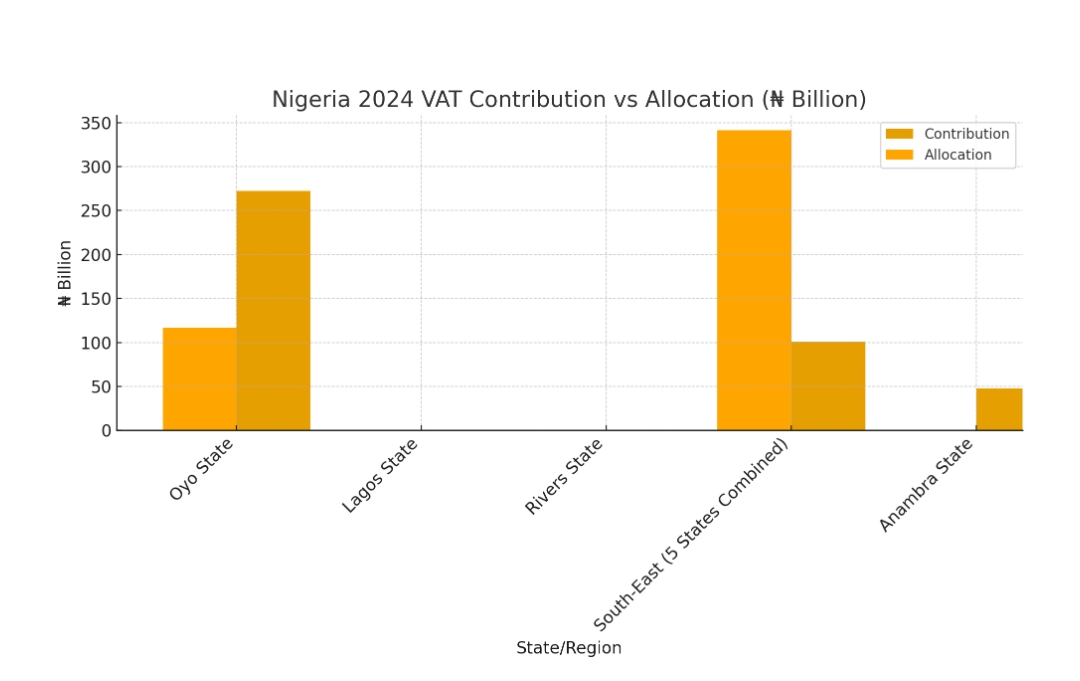
When conversations about Nigeria’s regional economic performance arise, Lagos State is often singled out as the model of prosperity — and people quickly point to seaports as the defining advantage. But that explanation collapses under scrutiny. If ports were the single most important determinant of state prosperity, how do we explain the exceptional performance of Oyo State — a landlocked state — which in 2024 contributed ₦272.41 billion in VAT to the federal purse while receiving only ₦116.83 billion?
Oyo State: A Landlocked Economic Powerhouse
Oyo is one of the most geographically disadvantaged states in Southern Nigeria in terms of proximity to ports. Almost every other Southern state is closer to at least one port — and many to multiple ports. Yet Oyo stands out among contributors to Nigeria’s GDP and federal revenue, ranking behind only Lagos and Rivers in VAT contributions for 2024.
The South-East Paradox
The five states in the South-East region together contributed only ₦101.09 billion in VAT in 2024, while receiving ₦341.45 billion in allocations. Many of those states are closer to Port Harcourt and Onne ports — and Rivers State receives major federal spending on port infrastructure. Onne Port alone handles around 65% of Nigeria’s maritime export volume. Yet the revenue picture remains skewed: proximity to ports has not translated automatically into higher VAT revenue for those states.
Oyo vs. Anambra (Onitsha River Port)
Anambra State’s Onitsha River Port has been commissioned multiple times since 1983, and significant federal funds have been invested over the decades. Nevertheless, Anambra generated only ₦47.53 billion in VAT in 2024 — far below Oyo’s figure. If the port explanation were decisive, Anambra should have been a standout contributor. The data shows otherwise.
Where Oyo’s VAT Revenue Comes From
Oyo’s strength is not maritime. Its VAT returns are driven by a diverse mix of productive sectors. In order of prominence they are:
- Agriculture — large-scale production and agribusiness processing (cassava, maize, yam, cocoa, etc.).
- Manufacturing — industrial estates around Ibadan with food processing, textiles and consumer goods production.
- Information & Communication Technology (ICT) — startups, telecoms, and related digital services growing the formal tax base.
- Mining & Quarrying — materials that feed construction and some export activities (granite, marble, etc.).
These sectors — properly harnessed — show that states can build sustainable revenue bases without relying on seaports. The key is policy, governance and execution.
Data Snapshot (2024 VAT Contribution & Allocation)
| State / Region | VAT Contribution (₦ Billion) | VAT Allocation (₦ Billion) |
|---|---|---|
| Oyo State | 272.41 | 116.83 |
| Lagos State | (Not provided) | (Not provided) |
| Rivers State | (Not provided) | (Not provided) |
| South-East (5 States Combined) | 101.09 | 341.45 |
| Anambra State | 47.53 | (Not specified) |
Notes: Figures above reflect the 2024 VAT data provided.
Inline Comparative Bar Chart (Contributions vs Allocations)
Leadership Over Geography
The decisive conclusion is straightforward: leadership matters more than geography. Oyo’s performance is a product of deliberate sectoral focus, investment-friendly policies, and effective mobilization of agriculture, manufacturing, ICT and mining. Other states can replicate this playbook by identifying and scaling their comparative advantages rather than blaming lack of seaports.
Policy takeaways
- Invest in sectors where the state has natural or developed advantages (agribusiness, manufacturing clusters, tech hubs, minerals).
- Improve ease-of-doing-business: predictable taxes, support for SMEs, and infrastructure for value chains.
- Build human capital: vocational training, tech incubation, and university-industry partnerships.
- Use data-driven budgeting and performance monitoring to track progress and adjust policies.