



Summary
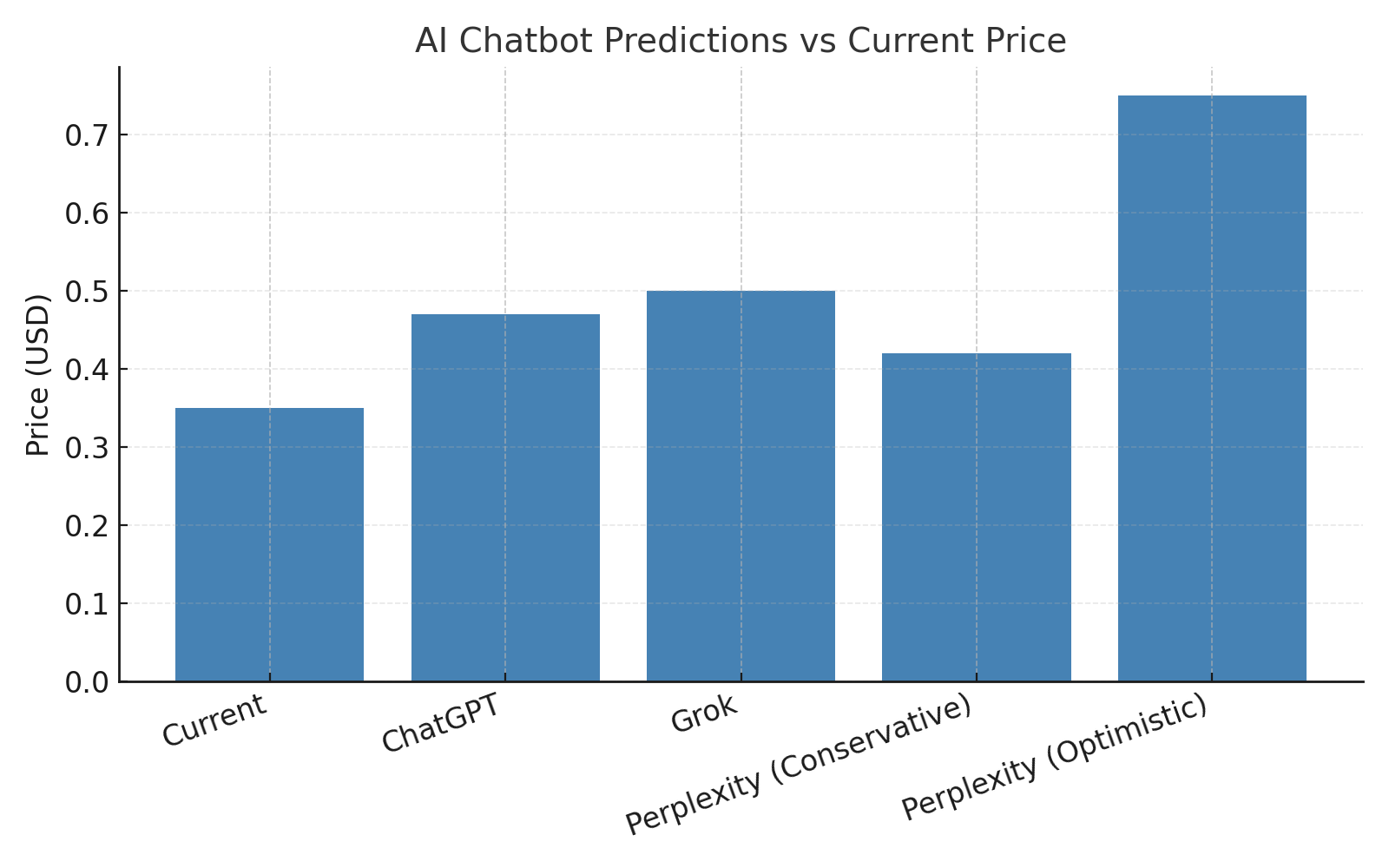
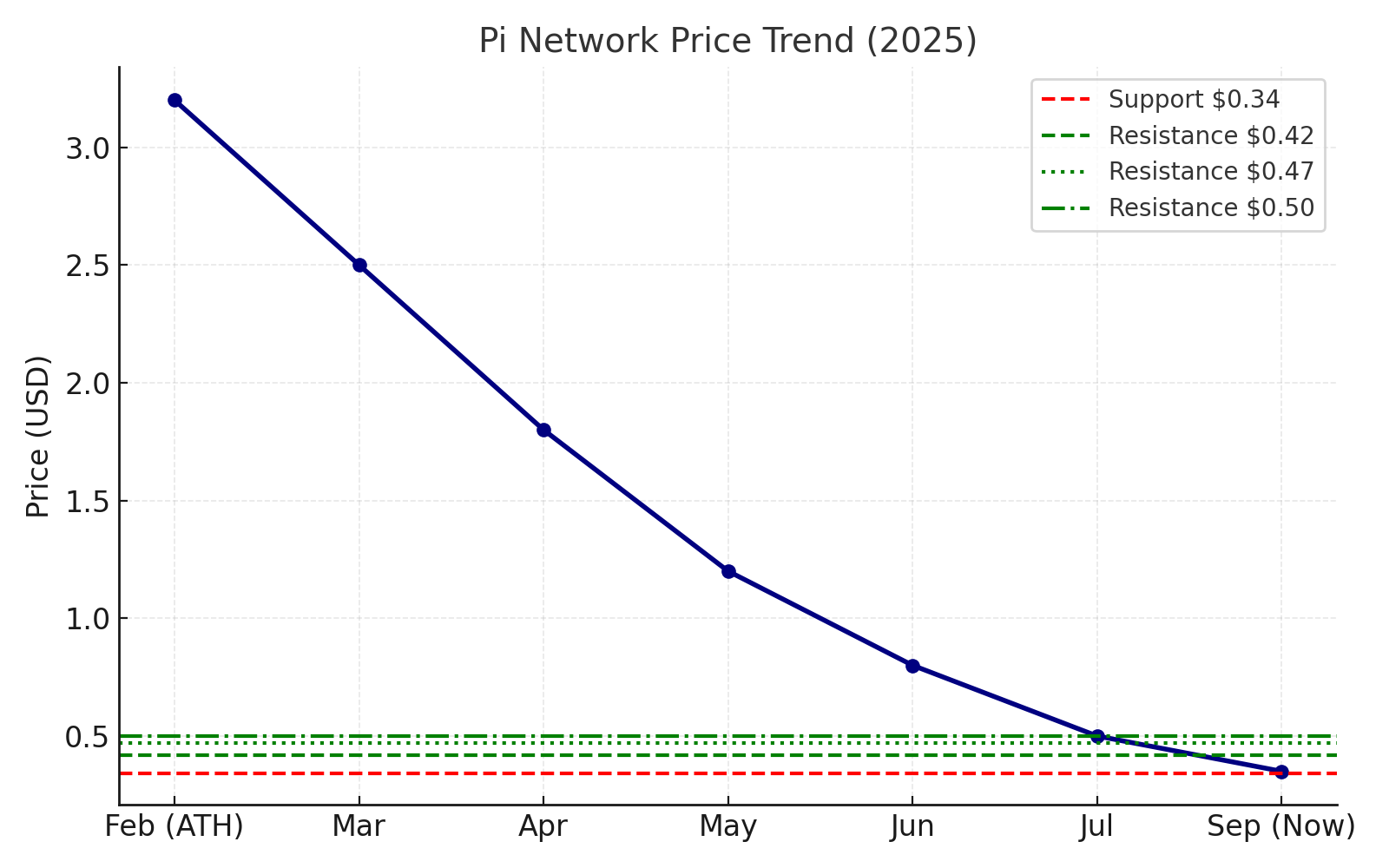
Pi Network’s native token has recently ticked upward — roughly 3% in 24 hours, trading near $0.35 per CoinGecko. AI-driven forecasts are mixed: ChatGPT offered a measured upside to around $0.47 (with downside risk if support breaks), Grok suggested a best-case target of $0.50 by month-end, and Perplexity’s range covered $0.42 (conservative) to $0.75 (optimistic).
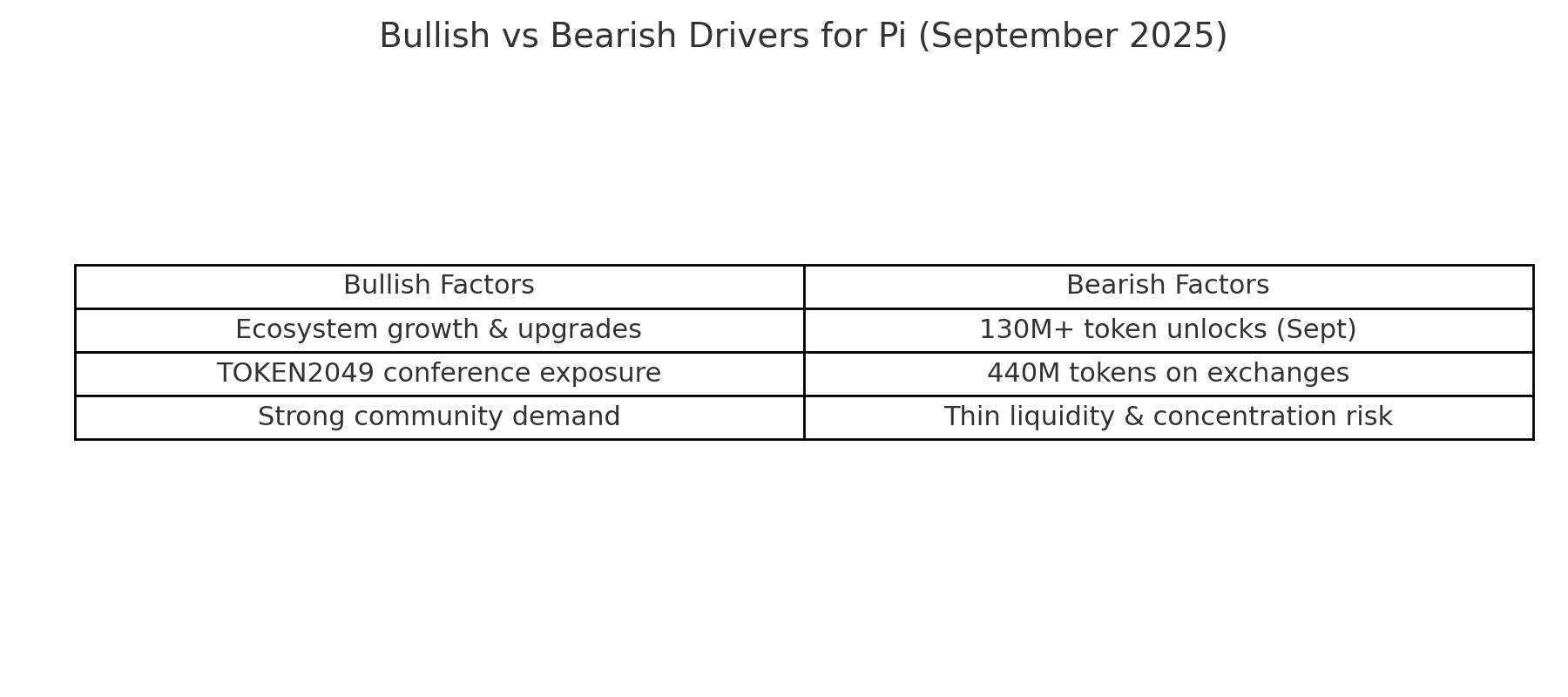
At the same time, supply-side risks are material: over 130 million PI tokens are scheduled to unlock in the coming weeks (including a single-day release of 13.2 million on Sept 21), and exchange reserves have climbed to a new high (about 440 million PI, concentrated heavily on a single exchange). These mechanics raise legitimate concerns about selling pressure.
This article explains, in approachable terms, the mechanics behind these forecasts and risks; compares Pi’s situation with historical token unlock events; breaks down the technical levels traders watch; outlines investor education steps; and presents balanced future scenarios. Our goal is to give readers the tools to understand “why” a rally might happen — and “why” it might not.
Part 1 — Quick Context: What Pi Is and Why It Matters
Pi Network began as a mobile-first experiment in inclusive crypto participation. Its user proposition was simple: ordinary people could “mine” Pi from their smartphones with minimal battery use, creating a broad base of early users without the resource-intensive mining model of earlier cryptocurrencies. Over several years the project built a large community of app users and “pioneers.” In 2025 Pi moved further toward public availability and exchange listings, which transitioned token ownership from an internal community-only model to market tradability.
Why that matters: community-driven projects often have enormous retail interest but relatively thin market liquidity at first. That makes them susceptible to large price swings when supply dynamics change — such as when large unlocks occur or when tokens shift from self-custody wallets to centralized exchanges.
Part 2 — What AI Chatbots Are Predicting, and How to Read Their Outputs
ChatGPT
- Bullish view: If market momentum continues and meaningful ecosystem developments are announced, Pi could rally to about $0.47 in the short term.
- Bearish view: If Pi breaks the technical support around $0.34, a correction to $0.30 (or lower) is possible.
How to interpret this: ChatGPT is summarizing plausible market mechanics — momentum + news can lift price, while technical breaks and supply shocks can produce downside.
Grok (X)
- Bullish inputs: Grok highlighted potential protocol upgrades, strong user growth signals, and publicity around Pi co-founder appearances (notably TOKEN2049).
- Best-case estimate: $0.50 by month-end in a scenario where news and user growth coincide.
Perplexity
- Conservative case: $0.42.
- Optimistic case: $0.75, while noting community targets like $1 are aspirational.
Part 3 — Supply-Side Realities: Token Unlocks and Exchange Inflows Explained
Token unlocks — what they are and why they matter
Many crypto projects distribute tokens over time. This is done to reward early supporters while attempting to avoid the immediate flooding of markets. But when tokens become transferable (“unlock”), holders can move them to exchanges and sell.
- Immediate effect: increased circulating supply available to sell.
- Price mechanic: If buyers don’t absorb the new sell volume, prices fall.
- Why timing matters: A large, concentrated unlock coinciding with weak demand usually exerts downward pressure.
In Pi’s case, the short-term schedule is significant: 130M+ tokens unlocking within 30 days — and 13.2M in one day — is a material supply shock.
Exchange inflows — the “ready-to-sell” metric
Tokens sitting in exchange wallets are easier to sell than those in self-custody. Rising exchange reserves are often interpreted as sellers lining up. Pi’s reserves have reached an all-time high of ~440M PI, with nearly 50% on Gate.io.
Part 4 — Technical Analysis Primer: Levels to Watch
Support: $0.34, followed by $0.30.
Resistance: $0.42, $0.47, and $0.50.
Volume confirmation and order book depth are critical. Price moves on thin volume are less reliable, while strong volume provides more validity.
Part 5 — Historical Case Studies and Lessons
Learning from past token events helps form realistic expectations.
- Unlock-led selloffs: often trigger sharp dumps followed by volatility.
- Event-driven pumps: real but often short-lived unless backed by utility.
- Utility-driven growth: the most sustainable path.
Part 6 — Investor Education: Practical Tools and Metrics
- Track exchange reserves
- Follow unlock calendars
- Monitor on-chain activity
- Check order book depth
- Balance social sentiment with hard data
- Apply position sizing and risk management
Part 7 — Scenario Planning: Best, Base, and Worst Case
Best Case
Event-driven rally to $0.47–$0.75; possible test of $1 if demand expands.
Base Case
Range-bound trading between $0.30–$0.50; rallies fade without demand.
Worst Case
Breakdown below $0.30; extended consolidation and selling pressure.
Part 8 — Community Dynamics and Psychological Traps
Confirmation bias, herding, FOMO, and overconfidence are common in token communities. Traders should counteract these with data-driven approaches.
Part 9 — Practical Playbook for Traders and Holders
- Active traders: monitor unlock dates, avoid thin liquidity, use limit orders.
- Long-term holders: check fundamentals, manage allocations, and consider DCA.
Part 10 — Metrics to Watch in the Next 30–90 Days
- Sept 21 unlock (13.2M tokens)
- Exchange reserves trend
- Conference impacts (TOKEN2049)
- New exchange listings
- On-chain usage metrics
Part 11 — Balanced Final Assessment
Pi has a plausible short-term rally chance, especially around events and hype. But large unlocks and exchange reserves create real downside risks. Long-term, sustainable growth depends on genuine adoption and utility, not just speculation.
Appendix: Glossary
- Unlock: moment tokens become transferable
- Exchange reserves: tokens in exchange wallets
- Support/Resistance: price levels where buying/selling pressure concentrates
- Market vs limit order: instant vs controlled execution
- DCA: dollar-cost averaging
Conclusion
There is a chance for a Pi rally, but it is not guaranteed. Traders should remain cautious, watch data-driven indicators, and apply disciplined risk management. The story of Pi’s price will be shaped by the push and pull between supply (unlocks, exchange inflows) and demand (ecosystem growth, community, and events).